
 By Khabar Rojana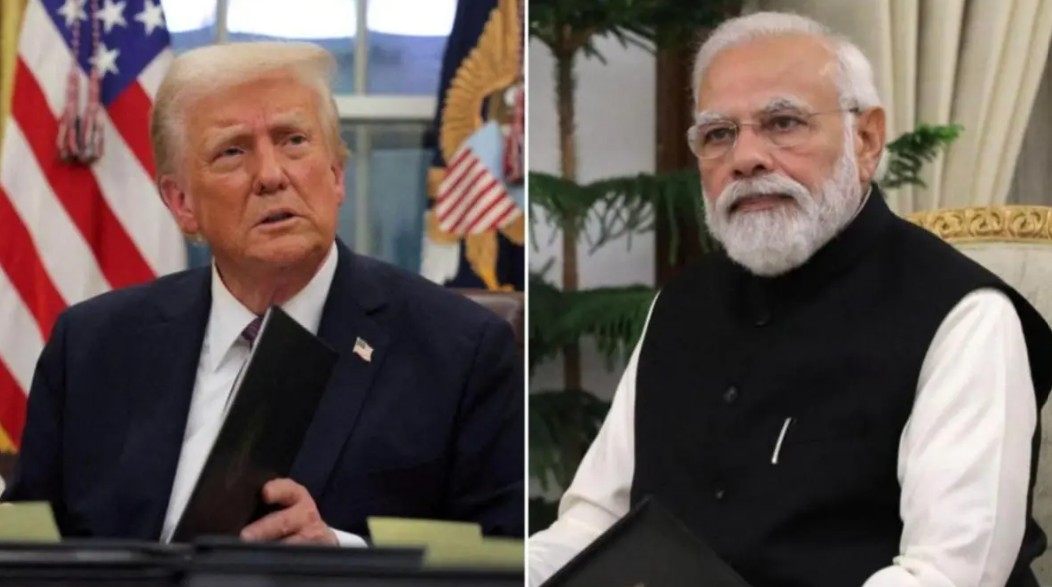
The window suggested by US Commerce Secretary Howard Lutnick for finalising an India–US trade agreement coincided with Operation Sindoor and its turbulent aftermath — a phase marked by US President Donald Trump repeatedly claiming credit for brokering a ceasefire between India and Pakistan. The claim, coupled with a visible warming of ties between Washington and Islamabad, cast a shadow over bilateral relations.
Lutnick said the trade deal was ready to be signed sometime between the announcement of US agreements with the UK on May 8 and Vietnam on July 2. However, he claimed the deal could not be closed because he expected Prime Minister Narendra Modi to personally call President Trump to finalise it — something India was allegedly “uncomfortable” doing.
India had launched Operation Sindoor on May 7, targeting terrorist infrastructure in Pakistan following the Pahalgam killings. The two countries witnessed four days of intense military exchanges before announcing a ceasefire on May 10. Minutes before the official announcements from New Delhi and Islamabad, Trump posted on social media claiming the ceasefire had been mediated by the US.
India has consistently rejected the mediation claim, maintaining that the ceasefire was achieved bilaterally at Pakistan’s request. Trump has continued to repeat his version in the weeks that followed, leading to visible strain in India–US relations.
According to Lutnick’s timeline, this was also the period when the US expected Modi to reach out to Trump to seal the trade pact. At the same time, Russia accounted for nearly 37% of India’s crude oil imports — a factor that later became a point of friction between the two countries.
In early August, Trump imposed an additional 25% penal tariff on India, citing its continued purchases of Russian oil. Lutnick later claimed that India had “missed the train” by about three weeks, as the US had already announced trade deals with other countries such as Vietnam and Indonesia. He said Trump follows a “staircase” approach to trade deals, offering the lowest tariffs to the first country that signs, with higher tariffs applied to subsequent agreements.
However, available data does not fully support this claim. The UK received the lowest tariff rate of 10%, while Vietnam — the second deal announced — was assigned 20%. Several countries that signed deals after Vietnam, including South Korea, Japan and members of the European Union and ASEAN, reportedly secured lower tariffs than India, which currently faces tariffs as high as 50%.
Trade experts note that negotiations between India and the US continued well beyond July 2025, with multiple official-level discussions on market access, tariffs and regulatory issues.
“If Washington had already decided in July that there would be ‘no deal’ simply because the Prime Minister did not make a personal call, there would have been little reason for negotiations to continue for months afterward,” said Ajay Srivastava, former trade officer and head of the Global Trade Research Initiative (GTRI). “The explanation sounds more like a retrospective justification than a contemporaneous reason.”
Srivastava added that major trade agreements hinge on complex policy differences — including agriculture, digital trade, tariffs and regulatory autonomy — rather than symbolic gestures such as leader-to-leader phone calls. According to him, Lutnick’s remarks blur diplomatic optics with negotiating realities.
While tensions linked to Operation Sindoor and India’s Russian oil imports added pressure to bilateral ties, the issue had not been publicly flagged by US officials as a deal-breaker before July. This suggests that energy imports were not initially seen as an obstacle when the trade agreement was reportedly close to completion.
 Shalu Shalu