
 By Khabar Rojana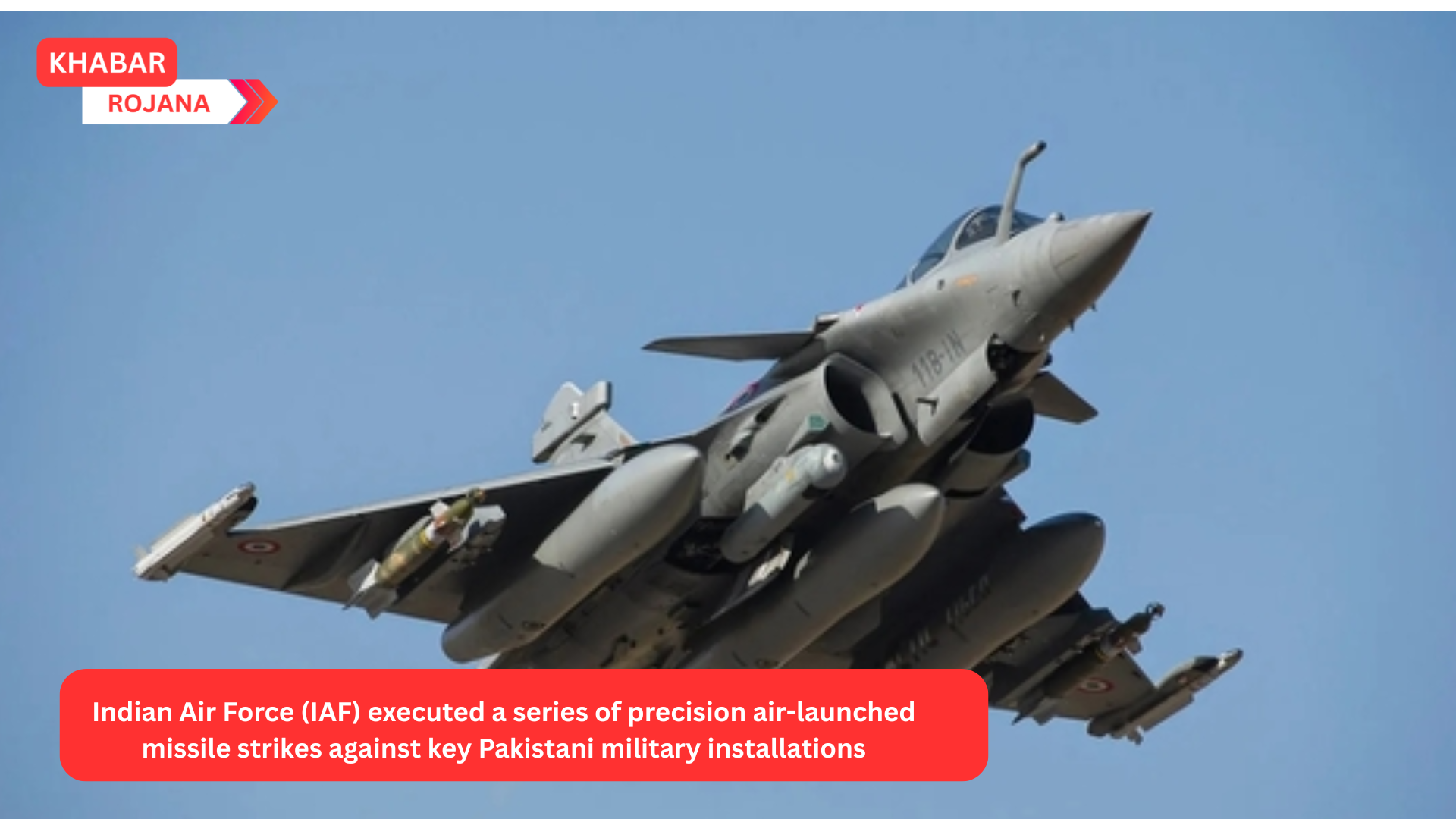
On May 10, 2025, the Indian Air Force (IAF) executed a series of precision air-launched missile strikes against key Pakistani military installations. This decisive action was in response to escalating hostilities, including Pakistan’s Operation Bunyan al-Marsoos, which targeted Indian military and civilian sites. The IAF’s counteroffensive, part of Operation Sindoor, aimed to neutralize Pakistan’s offensive capabilities and restore strategic balance in the region.
- Initiation of Operation Sindoor
In retaliation to Pakistan’s aggression, India launched Operation Sindoor, targeting multiple Pakistani airbases with precision-guided munitions. - Deployment of Advanced Missiles
The IAF utilized a combination of SCALP and BrahMos missiles, launched from Rafale and Su-30MKI aircraft, to ensure high accuracy and effectiveness against fortified targets. - Targeted Airbases and Infrastructure
Key Pakistani airbases, including Nur Khan (Chaklala), Murid, Rafiqui, Rahim Yar Khan, Sialkot, and others, were targeted to disrupt command and control networks. - Neutralization of Air Defense Systems
India’s strikes successfully destroyed Pakistan’s LY-80 and HQ-9 air defense systems, significantly degrading their aerial defense capabilities. - Use of Decoy Aircraft
The IAF employed dummy pilotless aircraft to mislead Pakistani defenses, allowing real strike aircraft to penetrate and hit designated targets effectively.
| Target Location | Strategic Importance | Outcome |
|---|---|---|
| Nur Khan (Chaklala) | Northern Air Command HQ | Command network disrupted |
| Murid | Drone operations and training | Facilities neutralized |
| Rafiqui (Shorkot) | Fighter aircraft base | Runways and hangars damaged |
| Rahim Yar Khan | Dual-use civil-military airbase | Operational capacity degraded |
| Sialkot | Radar installations | Surveillance capabilities impaired |
| Lahore | LY-80 air defense system | System destroyed |
| Karachi (Malir) | HQ-9 air defense system | System destroyed |
- S-400 Air Defense Activation
India’s S-400 systems intercepted multiple Pakistani aerial threats, including the downing of a SAAB-2000 AEW&C aircraft deep within Pakistani territory. - Destruction of Enemy Aircraft
The IAF reported the successful targeting and destruction of Pakistani C-130J, JF-17, and F-16 aircraft, both on the ground and in the air. - Naval Preparedness
The Indian Navy positioned assets near the Makran Coast, ready to strike Karachi Naval Port if necessary, showcasing a multi-domain operational readiness.
- Ceasefire Appeals
Following the IAF’s successful strikes, Pakistan sought U.S. intervention for a ceasefire, indicating the effectiveness of India’s military response. - International Mediation
Global powers, including the U.S. and Saudi Arabia, engaged in diplomatic efforts to de-escalate tensions and prevent further conflict.
India’s calculated and precise military response on May 10 demonstrated its commitment to national security and deterrence. The successful neutralization of key Pakistani military assets not only thwarted immediate threats but also reinforced India’s strategic posture in the region.
 Shalu Shalu