
 By Khabar Rojana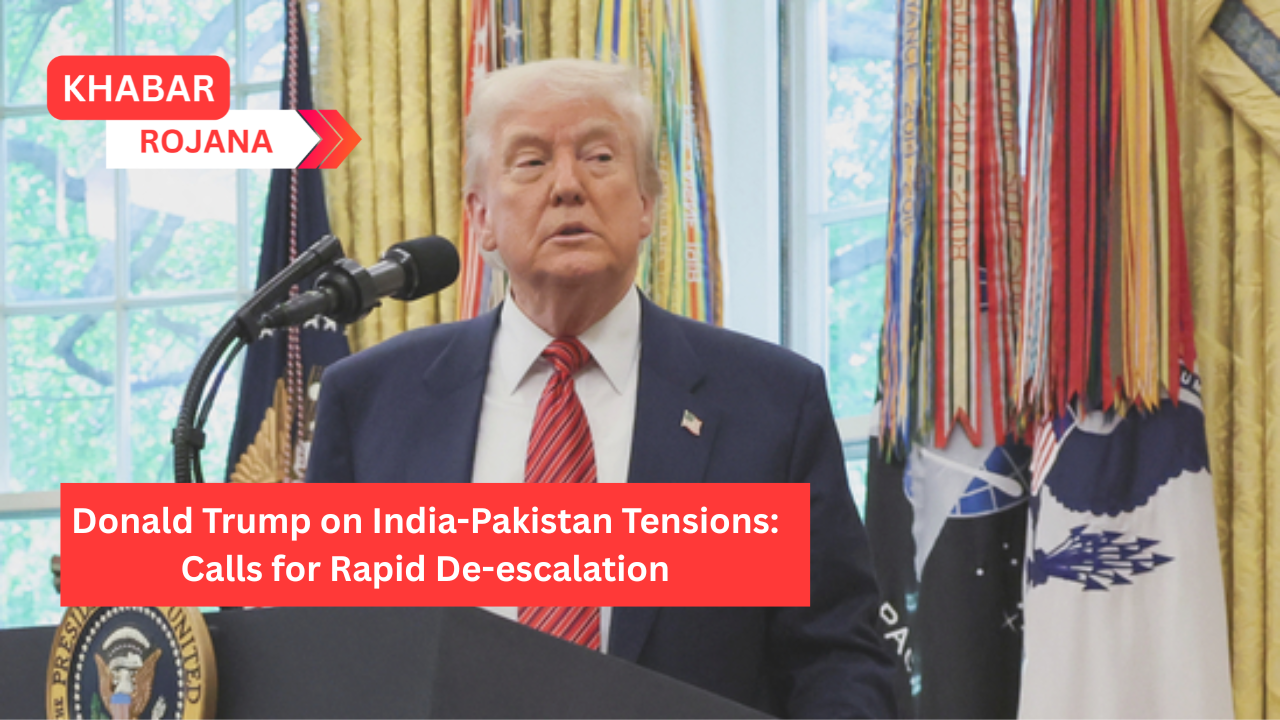
In the wake of escalating hostilities between India and Pakistan, U.S. President Donald Trump has expressed a strong desire for the conflict to de-escalate “as quickly as possible.” This statement comes amid heightened tensions following India’s military operations in Pakistan-administered Kashmir.
The recent surge in India-Pakistan tensions was triggered by India’s “Operation Sindoor,” a series of airstrikes targeting nine terrorist camps in Pakistan and Pakistan-occupied Kashmir. These strikes were in retaliation for the April 22 Pahalgam massacre, which resulted in the deaths of 26 people, predominantly tourists. The operation was aimed at dismantling terrorist infrastructure linked to groups operating from Pakistani soil.
White House Press Secretary Karoline Leavitt conveyed President Trump’s position, stating that he wants to see the situation de-escalate “as quickly as possible.” Leavitt acknowledged the long-standing nature of the India-Pakistan conflict, emphasizing the need for a swift resolution to prevent further escalation.
To facilitate de-escalation, U.S. Secretary of State Marco Rubio has been in continuous communication with leaders from both India and Pakistan. Rubio’s discussions have focused on urging both nations to engage in dialogue and take concrete steps towards reducing tensions. These efforts underscore the United States’ commitment to supporting peace and stability in the region.
In response to the escalating situation, Indian Foreign Secretary Vikram Misri condemned Pakistan for targeting places of worship, describing it as a new low for the country. India has reiterated its commitment to safeguarding its national security and has made it clear that it will resolutely counter any attempts by Pakistan to escalate tensions.
The United States has positioned itself as a facilitator for peace, offering to mediate between India and Pakistan if both parties agree. President Trump has expressed his willingness to assist in reducing tensions, highlighting the importance of bilateral dialogue between the two nations.
| Action Type | India | Pakistan |
|---|---|---|
| Military Operations | “Operation Sindoor” targeting terrorist camps | Retaliatory missile and drone strikes |
| Diplomatic Engagement | Continuous communication with U.S. officials | Engagement with U.S. Secretary of State |
| Public Statements | Condemnation of attacks on places of worship | Calls for international mediation |
| Security Measures | Strengthening of border security | Mobilization of military forces |
The international community has expressed concern over the escalating tensions. The Group of Seven (G7) nations have urged India and Pakistan to engage in direct dialogue to de-escalate hostilities. The United States has offered to facilitate “constructive talks” to help reduce tensions between the two nuclear-armed neighbors.
Moving forward, it is crucial for both India and Pakistan to prioritize dialogue and diplomatic engagement. The United States stands ready to assist in facilitating discussions aimed at achieving a peaceful resolution to the conflict. The international community continues to monitor the situation closely, emphasizing the importance of stability and peace in the region.
President Trump’s call for the rapid de-escalation of India-Pakistan tensions reflects the United States’ commitment to supporting peace and stability in South Asia. Through continued diplomatic efforts and open channels of communication, there is hope for a peaceful resolution to the ongoing conflict.
 Shalu Shalu