
 By Khabar Rojana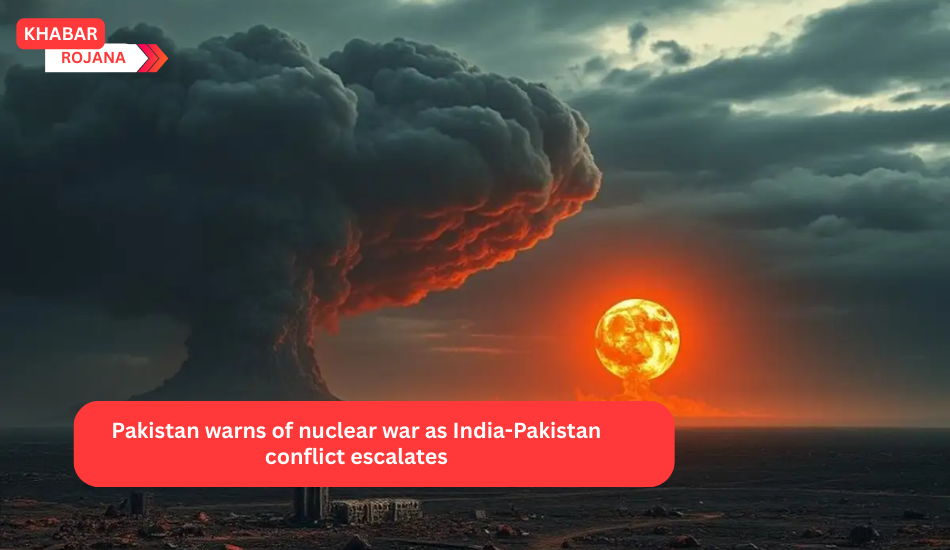
In a significant escalation of tensions between India and Pakistan, Pakistan’s Defense Minister, Khawaja Asif, has issued a stark warning, stating that the threat of nuclear war is “clear and present.” This development follows a series of military confrontations between the two nuclear-armed neighbors, raising global concerns about the potential for a catastrophic conflict.
Defense Minister Khawaja Asif emphasized that while Pakistan does not seek war, it will not hesitate to defend itself if provoked. His statement comes in the wake of India’s missile strikes on Pakistani territory, which Pakistan views as a severe escalation. Asif’s remarks underscore the gravity of the situation and the potential for further deterioration in bilateral relations.
The current crisis was triggered by a terrorist attack in Pahalgam, Indian-administered Kashmir, on April 22, 2025, which resulted in the deaths of 26 civilians. India attributed the attack to Pakistan-based militants and responded with “Operation Sindoor,” a series of missile strikes targeting alleged terrorist infrastructure in Pakistan. Pakistan retaliated by shooting down Indian drones and launching its own attacks, leading to casualties on both sides.
Both India and Pakistan possess significant nuclear arsenals. India has approximately 130-140 nuclear warheads, while Pakistan is estimated to have around 140-150. Both countries have developed various delivery systems, including ballistic missiles and aircraft, capable of delivering nuclear payloads.
| Aspect | India | Pakistan |
|---|---|---|
| Estimated Warheads | 130-140 | 140-150 |
| Delivery Systems | Ballistic missiles, aircraft | Ballistic missiles, aircraft |
| Nuclear Doctrine | No first use | First use under certain conditions |
The international community has expressed deep concern over the escalating tensions. Former U.S. President Donald Trump has offered to mediate between the two nations, urging both sides to exercise restraint. Other global leaders and organizations have called for immediate de-escalation to prevent a full-scale war.
India and Pakistan have a long history of conflict, having fought three major wars since their independence in 1947. The Kashmir region has been a persistent source of tension, with both countries claiming it in full but controlling only parts. Previous agreements, such as the Lahore Declaration, aimed to reduce the risk of nuclear conflict, but recent events have strained these commitments.
As of now, both nations remain on high alert, with military forces mobilized along the border. Diplomatic channels are being explored to de-escalate the situation, but the path to peace remains uncertain. The potential for miscalculation or accidental engagement poses a significant risk.
 Shalu Shalu